

Choosing a health plan during your Open Enrollment can get confusing fast. You're looking at premiums, providers, prescriptions, out-of-pocket costs, and what happens when you need care.
If a copay-only plan is one of the options your employer offers, comparing it to other plan options is pretty easy to understand. Instead of meeting a deductible and then calculating coinsurance, your covered care is set by specific copays. With the Coupe copay-only plan design, members can see their copays before choosing a provider or receiving care.
If you need a refresher on those cost-sharing terms, check out our Copay vs. Deductible resource.
Let's review four reasons a copay-only plan design might be a good fit for you.
1. Understand upfront costs before getting care.
A copay-only health plan uses set copays for covered services, instead of asking you to calculate deductible and coinsurance amounts each time you get care.
With a traditional deductible plan, you may pay toward a deductible before the plan begins sharing certain costs. Coinsurance may apply after that, depending on the plan.
“You don’t have a deductible, you don’t have coinsurance, you don’t have to do the math.”
Mark Menton, President and General Manager of Coupe Health
You may have heard the phrase “price transparency.” Government legislation — starting with the Affordable Care Act in 2010 — requires hospitals and health plans to disclose pricing information. Even so, consumers face widespread confusion and frustration because price ranges do not always make it clear what they will actually pay for care. [1]
Coupe closes this price certainty gap. Members always see a specific copay before receiving care, so they have upfront pricing and can plan ahead. [2]
"Transparency is interesting. Certainty is where it’s at."
Mark Menton
2. Enjoy bundled copays.
Some visits or procedures can include more than one service. With the Coupe copay-only plan design, certain eligible services may be combined under one bundled copay instead of leaving you with several copays to track.
Here's an example:
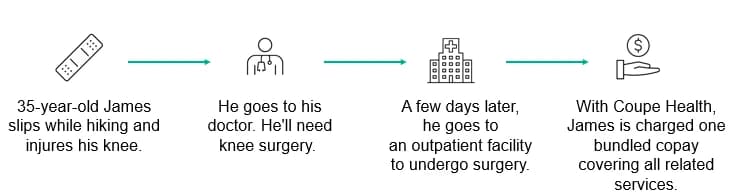
Not everything can be bundled, and your employer determines how services are covered. However, when bundling applies, it can make costs easier to understand.
3. Access a broad network of providers.
Coupe uses a broad national preferred provider organization (PPO) network, with access to 2.2 million providers,* so you can choose from a large number of doctors and hospitals. [3]
Coupe also gives you more information when comparing providers. Providers are rated Preferred, Standard, or Non-Preferred based on quality, appropriateness of care, and cost-efficiency. With Coupe, the highest-value providers usually have the lowest copays. [3]
These provider ratings give you more information without limiting your ability to choose any in-network provider.
4. Get personalized support from an expert.
Many routine benefit questions can be handled digitally. Coupe’s intuitive app and member portal give you access to your coverage information right at your fingertips, whether at home or on the go. [4]
Coupe understands that sometimes you need more than an app to get your answers. That’s where the Coupe Health Valets come in.
Health Valets are real people who can help with nonclinical questions, provider searches, scheduling doctor appointments, and other day-to-day benefit-related needs. Plus, Coupe offers additional support by helping you understand available care options for ongoing or more complex health conditions.
Health Valets are available to anyone considering Coupe during Open Enrollment, to help you choose your benefits and the support you want during your plan year.
What to know before you enroll.
Now that we’ve covered why a Coupe copay-only plan design may be a great option for you, let’s take a look at what Mark recommends you understand before you enroll.
1. Benefits and likely costs.
Look beyond the monthly premium. Think about the care you already use or expect to receive next year. That might include routine visits, specialists, labs, imaging, urgent care, therapy, or other services.
You don’t have to predict every healthcare expense. The point is to get a more realistic idea of how each plan works with the care that’s most relevant to you.
2. Provider network and ratings.
Check the doctors, specialists, and clinics you use. Then look at what happens if you need someone new. Do your plan options let you compare provider status, quality, and expected cost before making an appointment?
3. Prescription coverage.
Make a list of the medications you take regularly. Before you sign up, check to see if your medications are covered, what you’ll pay, and if there are any requirements you should know about.
Plans may cover prescriptions differently, so look at the details.
4. Human support.
Think about what happens when the answer isn’t right in front of you. Can you reach someone for a nonclinical question, get help finding a provider, or get assistance to schedule care? Is there human support available, if you’re not sure what to do?
Ready to choose Coupe?
Coupe offers a smarter way to manage your healthcare costs. Coupe members can:
- Check copays before they go for care.
- Choose from national providers.
- Get human support.
If Coupe is a healthcare option available through your employer, review your Open Enrollment materials and choose what works best for your healthcare needs.
About Mark Menton
Mark has 30 years of expertise in the software industry, with more than two decades focused on improving healthcare services through innovative technology solutions. Beginning in 2016, Menton served as CEO of HealthSparq, where he built the leading provider search and price transparency tools for health plan members across the country. After the company was acquired by Kyruus in 2021, he transitioned to General Manager where he was responsible for product innovation and client adoption in the health plan market. Prior to HealthSparq, Menton served as the CEO of Clarus Health Solutions, where he built a provider search business from the ground up, winning deals with regional and national payers. Clarus was bought by HealthSparq in 2014.
Details matter. Coverage, costs, provider access, and eligibility may vary by employer and plan. This article is for general information purposes only. Coverage or costs are not guaranteed. Review your plan documents or contact a Health Valet with Coupe-specific questions.
Sources
1. HealthCare.gov: 3 Things to Know Before You Pick a Health Insurance Plan
2. Coupe Health: Price Certainty
3. Coupe Health: Green Preferred Provider
5. Coupe Health: Copay vs. Deductible
*Provider access: National dataset.